Category Archives: geology

181. The Ophelia of Suburbia – Hogsmill River, Ewell

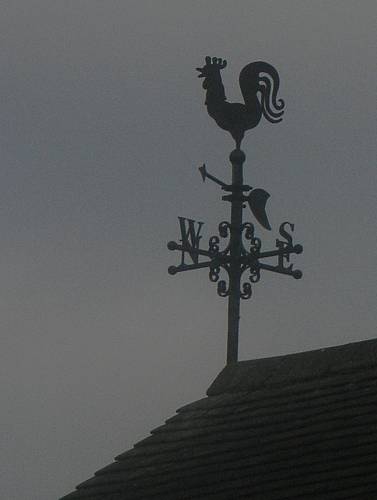
weathercock-ewell-surrey-england-by-robert-brook-flickrThe rain is falling softly beneath a grey and weeping sky.

Dull, wet, oppressive sinks the afternoon, through a rising restlessness I can’t define. Puddles beneath my feet. Familiar streets chiding my every turn.

Northeastwards from here in Epsom, the city stretches wide. Twenty miles to London Bridge, and as many reaching out beyond. The megalopolis, looming heavy in the rain.
Continue reading

175. The price of oil: peak petroleum production and energy economics in a thirsty world

NOTE: May 2009 — For further updates on the oil price, see also:
The price of oil: 3 — energy economics and the financial crisis;
The price of oil: 4 – a rising road ahead.

north-sea-oil-rig-and-helicopter-offshorepictures.jpgIt was a chilly evening in early February when the Managing Director called us all together. He paused a moment, glanced at the expectant faces all around him, and then he started.

Business is tough, he said, and we’re doing what we can. But finally, we’ve reached that moment when we’ve got to let some of you go.

A hundred of us stood there then, looking at each other, at the floor, and at the winter’s dusk outside.

There was silence. Some more explanation was required, and some more honesty was needed. And, to his credit, Mitch provided it. As ‘this company is going down the toilet’ talks go, it was pretty fairly done.

We’d had problems with one of our installations in the North Sea, he told us. We all knew that already. In the big money business of finding oil and gas and getting them to the beach, failing on either of those priorities was never good.

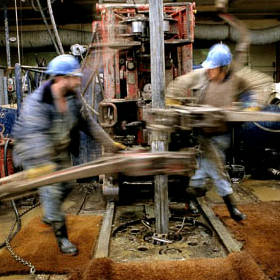
roustabouts-on-the-drill-floor.jpgAn asset team would miss its targets, and there’d be no bonuses or payrises for anyone ahead. Such is business, in any organisation. But this time, it was worse.

It’s the oil price, he said. February, 1999. Continue reading

169. Down tracks and cracks in Paris and London – Tate Modern and the 1812 from Waterloo

waterloo-eurostar-station-by-jan-hanford-on-flickrdotcom.jpgRain. River. November. On the long-awaited day that Paris came closer to London.

As I step on to the platform under a damp grey sky, there’s a farewell party in full swing around the station.

After thirteen years, the last Eurostar will depart here in a few hours’ time. And in the morning, when the first train arrives at a gleaming new St Pancras across the Thames, Paris will be just two hours and fifteen rail minutes from London.

Fog in the Channel – Continent Isolated’. So read the famous newspaper headline of yore. Not any more. This rapprochement is almost complete.
Continue reading

158. How evolution works

If life evolves steadily from one species to another, then why do homo sapiens and chimpanzees still co-exist ? That’s a classic question, and one which goes right to the heart of evolution.

It’s important to our understanding of how all life forms develop, and to reconstructing the the evolution of early man (thanks to Ella for the link).

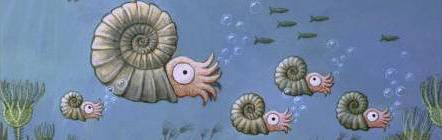
ammonites2.jpg

The point is that whilst evolution is a slow process, the mechanism which allows change to happen is not a gradual one at all. We might see Darwin’s drawings of Galapagos finches as a continuous spectrum of evolutionary development, but perhaps that sketch gives quite a false impression of how evolution really works.

When evolutionary change takes place, it does so rapidly and abruptly.
Continue reading

144. East of Eden – evolution and enlightenment

east-of-eden.jpgThe wonder of geology, to me, is that it’s so much more than a study of inanimate rocks and stones. It’s a history of our planet, of life on Earth, and even of time itself.

The landscapes and seas around us, our climate, the plants and animals we depend upon to live, the resources we use whenever we go anywhere or make anything – geology is a route towards the understanding of all those things.

Every historian and foreign correspondent knows that in order truly to know the present and to predict the future, we have to understand the past.

dinosaur-footprints.jpgAnd that is what geology gives us. Geology is a unifying discipline, which borrows so much from other science, and puts it all together to reveal the history of our planet and of life both past and present.

It’s so much of what we know about our world, and about ourselves as well.

But there’s a debate going on, right now, in the most developed country in the world, about whether any of it is true.
Continue reading

129. Tenerife – 1: the light at the end of the world

Seven human lifetimes ago, the mountain behind me was alive.

Smoke, fire and brimstone poured into the blue Atlantic sky, day and night.

129_santa-maria.jpgThe crews of three small sailing boats watched the terrifying spectacle from the safety of the next island, fearful of such a bad omen whilst their epic journey had hardly commenced. The captain of their little fleet had no choice then but to portray it calmly, or maybe not quite so calmly, as a certain sign of heavenly goodwill instead.

129_1492_vangelis.jpgTwo weeks later, in September 1492, the three tiny vessels left the safety of the Canary Islands, slipped their moorings in San Sebastián on La Gomera, and bravely sailed off the edge of the world. The first voyage of Christopher Columbus and the Santa Maria had begun.
Continue reading