Category Archives: history

75. The Cruel Sea – the Indian Ocean tsunami

“We learn geology the morning after the earthquake”.
Ralph Waldo Emerson – American poet, lecturer and essayist (1803-1882).

“We have very little control over external forces such as tornadoes, earthquakes, floods, disasters, illness and pain. What really matters is …. How do I respond to those disasters ? Over that I have complete control.”
Leo F. Buscaglia – American guru and Professor at the University of Southern California (1924-1998).

“An earthquake achieves what the law promises but does not in practice maintain – the equality of all men.”
Ignazio Silone – Italian author and earthquake orphan (1900-1978).

tsunami-2004-indian-ocean.jpg
(Photos © AP, AFP, Getty Images)

If ever there were a week for new perspectives, then this is it.
Continue reading

65. In the footsteps of Brunel: Bristol Half Marathon

clifton-suspension-bridge.jpgThe famous Victorian engineer Isambard Kingdom Brunel was truly one of the Great Britons, always undaunted by a challenge.

It’s just a couple of hours from London to Bristol now, and the train journey is even faster. But before Brunel, the journey could take several days.

Brunel’s dream was to build a railway between the two cities, whatever the obstacles. The Great Western Railway, as it came to be known, heads westwards out of London, making undistinguished progress most of the way to its destination. It is only near its goal, that the real engineering problem was to be faced. Just east of Bath, the route had to somehow traverse the steep escarpment, where the Jurassic Great Oolite defines the pretty escarpment of the Cotswold Hills.

Continue reading

44. Bath Half Marathon: Minerva’s revenge

bath-spring-rain.jpgWelcome to Bath – UNESCO World Heritage Site‘ – reads the roadsign, rather incongruously greeting the weary traveller at this dull spot between the railway line and the Texaco garage. Four miles have gone by in the lashing rain and there are another nine to go in the Bath Half Marathon.

Bath is famous for its hot springs, and there is no doubt at all that the aquifer is being fully recharged in the foggy hills around the town. The goddess Minerva presided over the Roman baths built here, and the weather she’s organised is extracting a bitter revenge on the runners gathered for the race. Even the glorious pale gold of the Bath stone mansions in Great Pultney Street had looked a bit drab as we’d shivered back at the start line, waiting for a delay just long enough for the rain to arrive.

All that Georgian architecture is far behind us here, and a third of the race is already run. Continue reading

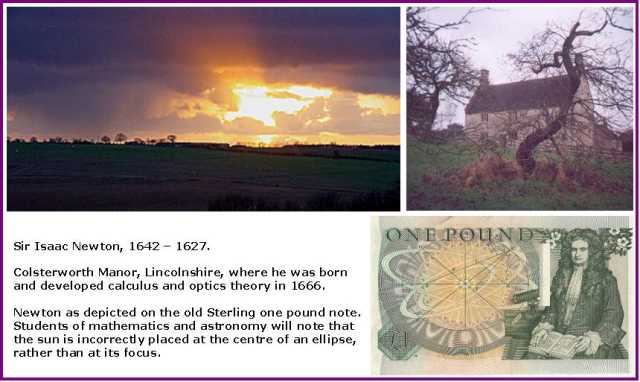
41. A Lincolnshire legend – Sir Isaac Newton

sir-isaac-newton-woolsthorpe-lincolnshire.jpg
Nature and Nature’s laws lay hid in night
God said “Let Newton be!”
And all was light.
Alexander Pope

A hundred miles north of the capital, the A1 London – Edinburgh road crosses a forgotten and largely empty swathe of farmland. Forgotten because today it’s on the way to somewhere, but at the centre of nowhere. And empty because of what happened here more than six centuries ago. The Black Death arrived suddenly in Lincolnshire, in September 1348, but, within a few weeks, a third of the population was dead, and this once prosperous and populated piece of agricultural England lay devastated.
Continue reading

39. Woking – from Necropolis to Technology Junction

woking-railway-hg-wells-ottershaw-church-and-wey-navigation.jpgIt’s an unsatisfactory sort of place now, but once it must have been a pleasant hamlet beside the River Wey.

This oft-flooded piece of grazing land, named in the Domesday Book of 1086, now carries the name of Old Woking, dwarfed by the newer town to the north.

A Saxon monastery once stood here, but when the railway arrived in 1838, nine astonishing years after Stephenson’s Rocket had changed travel for ever, this was a blasted and empty heath. Woking Common was just a deserted staging post as the tracks grew to Southampton in the west and Portsmouth to the south. Continue reading

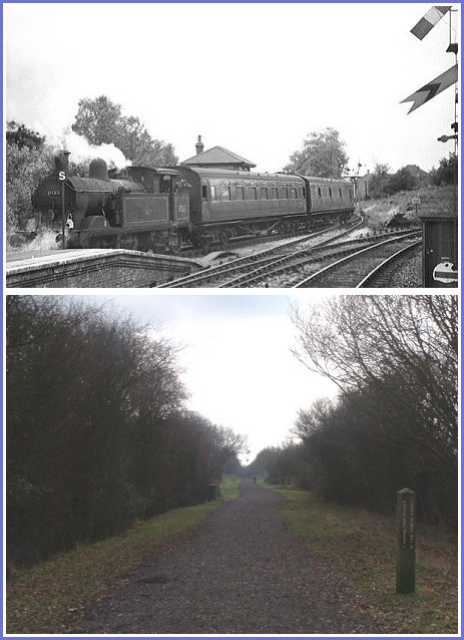
37. Lord Beeching and me – the Worth Way

Another week, and another long run, which this time I’ve scheduled from Crawley. Theoretically it’s possible to fit the miles around ring roads and residential streets, but although that type of running can make for an enjoyable sort of fartlek, I’ve a different kind of excursion in mind today.

the-worth-way-crawley-to-east-grinstead-railway.jpgThe route I’ve planned crosses the suburban landscapes to Three Bridges, where I leave the sixties estates to pick up a cycle track along the Worth Way. Passing Worth church, in part built by the Saxons, my run heads across the M23 Brighton motorway and into the Sussex farmland beyond.

Just four miles into my outing, and I’m standing outside a smelly cowshed with green fields all around me, questioning my sanity. Twelve miles to go, and my legs should be feeling much better than this. But somehow they don’t, and I can see a struggle looming worryingly up ahead.

The track crosses the road to Turners Hill, scene of many an office outing to the Red Lion pub, to rejoin the course of the old railway, for the Worth Way follows the course of an old branch line. Continue reading